Fighting fire with fire
The village and fighting fire with fire
In an age of individualism…of “I don’t need anyone-ism”…I often talk about how it takes a village.
Not because I think independence is a bad thing. I love being capable and self-sufficient. But I wonder what happens when independence becomes isolation.
Perhaps because I have seen, quite literally, what happens when a community has to come together.
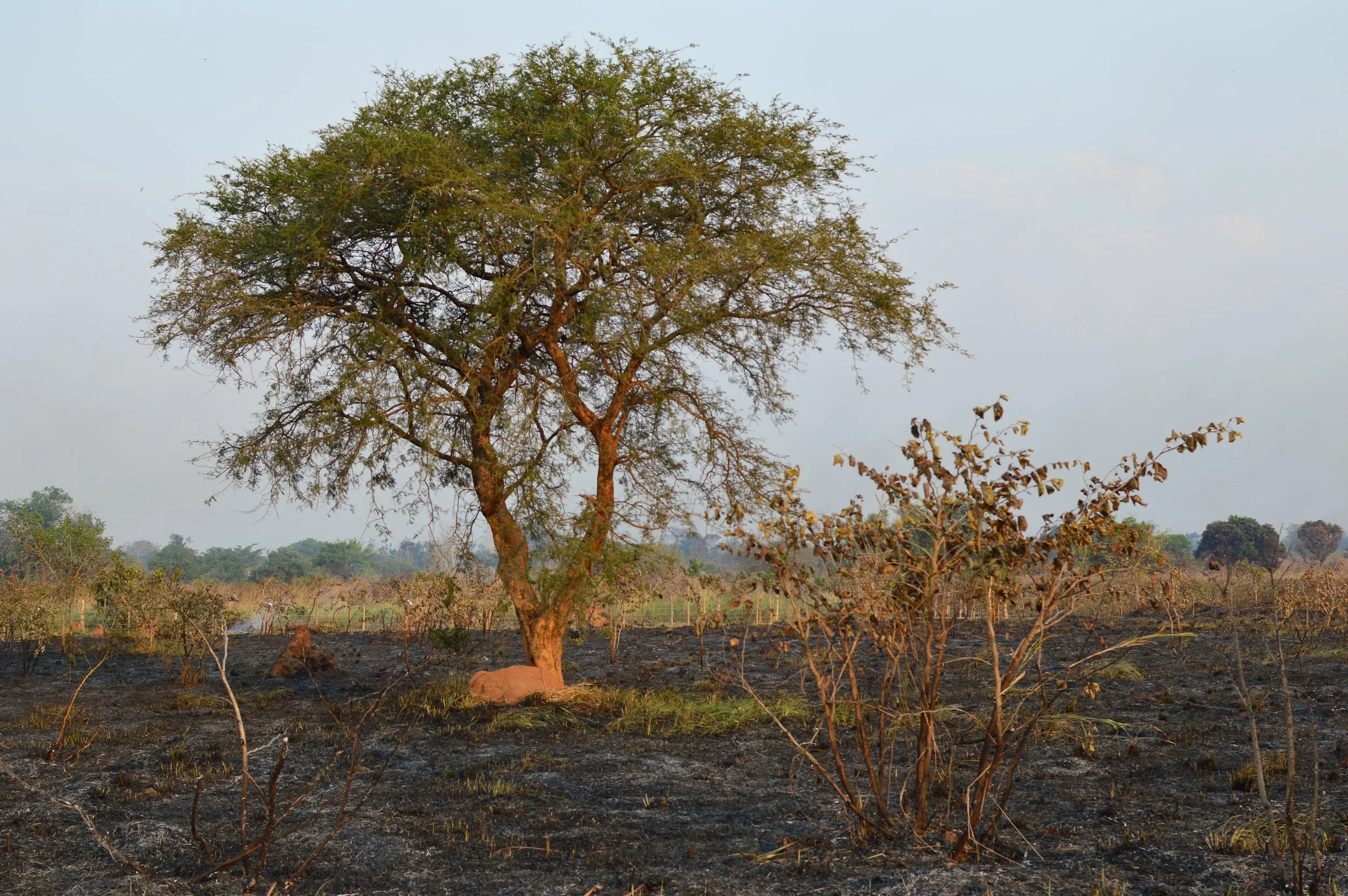
A couple of years ago, there was a fire near our village farmhouse in Northern Uganda.
It started, somewhat ironically, after some people in the village had been hunting rats to sell in Kampala. As part of this, they had been setting small fires in the surrounding grass to catch the rats.
Soon, the neighbourhood was on fire. Wildfire. In the dry season. It was crazy. The ecological and socioeconomic context behind practices like this is a conversation for another day.
When I returned to England and was later relaying the story to my work colleagues, they joked that I had somehow managed to attend the Rat Fire Festival.
It would have been funny had we not been in the middle of nowhere, surrounded by bush that was rapidly burning, with no fire trucks anywhere in sight.
There was, however, a village fire brigade.
Albeit not quite what you might imagine.
Basically, nearby villagers coming together on foot to help. With whatever they had.
Access to water was sparse. There was a makeshift pipe that could bring water from the nearby river, if there was enough water in the river and, presumably, if the pipe was long enough.
This was not suitable for this situation. And we didn’t have time.
So what happened here, where we didn’t have enough water to put out a bush fire?
The solution was to fight fire with fire.
As a city girl, you can imagine this scene was wild to me.
I had heard the expression; but I had never really understood its origins until I was standing there watching people deliberately set another fire in order to stop the first one spreading.
It felt completely counterintuitive. And yet, it worked.
I was incredibly grateful and humbled, in that moment, by the sheer bravery and collective action of the village.
It made me think about my life in London.
Where is my village?
London gives us extraordinary independence. And that is, in many ways, a privilege. But I sometimes wonder whether the very systems that make life simpler can also make it easier to become disconnected from one another.
We can have everything delivered. We can call the fire brigade if there is a fire. If we're not careful we can hide out and barely see another human being for days.
There is a darker side to this independence too.
We can become so disconnected that we can be unwell, or even die, and it can take days before someone realises (for those that live alone).
We are often encouraged to be self-sufficient and somewhere along the way, we can start to believe that needing other people is evidence that we haven't quite got it together. That we're a burden. That we should be able to figure it out ourselves.
The world may tell you otherwise, but I really don't think we are designed to do this life alone.
Holt-Lunstad's 2010 meta-analysis found that stronger social relationships were associated with a lower risk of mortality.
Perhaps, our villages are not just nice to have but are part of how we survive.
So, who is in your village?
Not the people you follow, your LinkedIn network or social media followers. Not the hundreds of contacts sitting in your phone.
Your actual village.
Who do you call when you need:
perspective to help you see the bigger picture?
courage and a reminder that you're capable of more?
wisdom from someone who has already walked the path you're considering?
a safe space where you don't need to be fixed?
challenge from someone who will lovingly tell you what you might not want to hear?
practical help from someone who can actually aid you get something done?
And then ask yourself the slightly more uncomfortable question: Where is the gap?
Your village isn't necessarily the people you were born with. Sometimes you have to build it.
A small challenge:
Choose one person.
It doesn't have to be a mentor. It doesn't have to be someone senior to you. It might simply be someone you trust enough to say, ‘Can I talk something through with you?’
You don't need to wait until everything is on fire. We should not really be building our villages in the middle of a crisis.
We build them beforehand, so that when the fire comes, they can help us fight it, or perhaps prevent it from spreading in the first place.
It takes a village.
This week I have been…
Listening: 'Unathi' by Frigid Armadillo
If you found this reflection useful, forward it to one person who would appreciate it.
Thank you and see you next month.